Vittorio Palladino

Hi, I am Vittorio! I am a robotics researcher working on safe motion planning and perception for autonomous aerial robots. I am a dual Master's student at the University of Illinois Chicago and Politecnico di Milano. At UIC I am a Research Assistant working on high-performance computing research in collaboration with Argonne National Laboratory, focusing on energy-aware inference for multimodal LLMs.

In summer 2026 I joined UC Berkeley as a visiting research student in the HiPeRLab, advised by Prof. Mark W. Mueller, working on occlusion aware motion planning and LiDAR-based perception for autonomous UAV.

I am interested in safe motion planning under uncertainty, perception-aware control, optimization for robotics and AI planning.

motion planningperceptionautonomous UAVsoptimization

Selected Publications

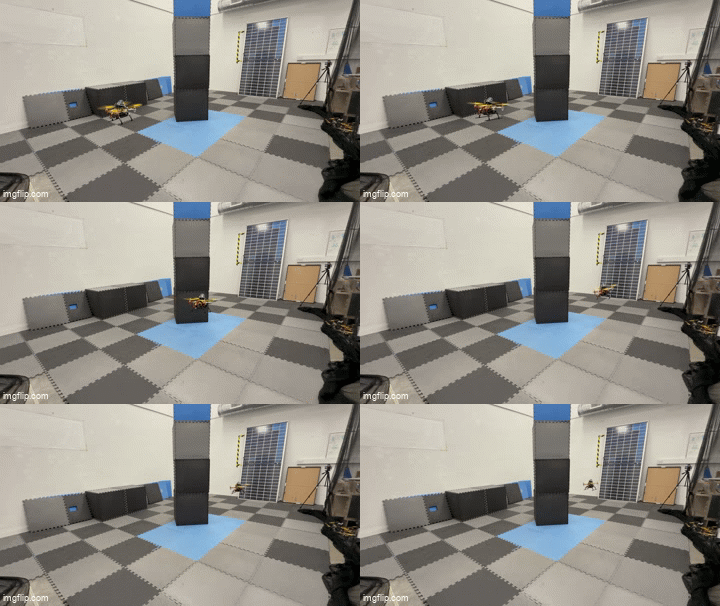
OA-MPPI occlusion-aware quadrotor flight

OA-MPPI: Obstacle- and Occlusion-Aware Model Predictive Path Integral Control for Quadrotor Flight

Vittorio Palladino, Teaya Yang, Ruiqi Zhang, Mark W. Mueller

In review: International Conference on Robotics and Automation (ICRA), 2027 · arXiv:2609.28709

Autonomous UAV flight through cluttered and partially unknown environments requires reasoning not only about observed obstacles but also about occluded regions that the sensor cannot observe. We present OA-MPPI, an obstacle- and occlusion-aware extension of Model Predictive Path Integral (MPPI) control for quadrotor flight that accounts for potential moving agents emerging from these regions into the vehicle's path. At every planning step, we extract a 3D occlusion boundary from the online occupancy map and use it to model the regions that hidden agents could reach over the prediction horizon. We penalize trajectories that enter these expanding regions within MPPI rollouts generated using nonlinear quadrotor dynamics and accounting for individual rotor thrust limits. We validate the proposed approach in simulation and hardware flight experiments, with the complete pipeline running onboard the vehicle in real time. Results show increased clearance from occlusion boundaries compared to baseline MPPI in both settings, as well as avoidance of an agent emerging from occlusion in simulation.
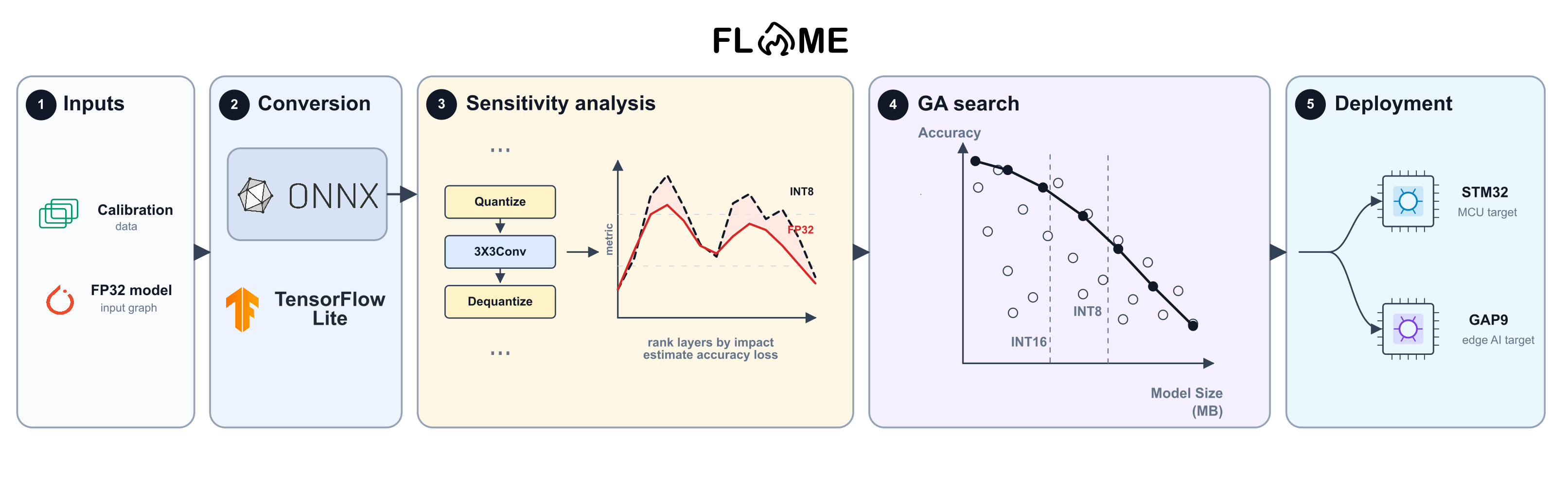
FLAME mixed-precision quantization framework

FLAME: A Deployable Framework for Layer-wise Automatic Mixed-Precision Quantization on Embedded Devices

Greta Corti, Matteo Vitali, Vittorio Palladino, Nicolò Vacis, Luca Merigo, Sara Pidò, Matteo Matteucci

In review: ACM Transactions on Mathematical Software ·

Deploying deep neural networks on resource-constrained embedded devices requires models that are both accurate and efficient in memory footprint and compute cost. Uniform INT8 quantization is simple and widely supported by embedded inference toolchains, but it can degrade accuracy beyond acceptable limits for tasks sensitive to low-precision arithmetic. Mixed-precision quantization can recover accuracy by assigning different precisions to different layers, but it introduces a combinatorial search problem, and many existing methods require retraining or lack a complete path to deployment. We introduce FLAME, a training-free ONNX-based framework for automatic mixed-precision quantization targeting embedded deployment. Given a pretrained PyTorch model, FLAME converts it to ONNX, estimates layer-wise sensitivity via statistical distances between FP32 and INT8 activations, and applies a genetic algorithm guided by a sigmoid-gated fitness function over task performance, model size, and CPU-measured inference time. We validate FLAME on YOLOv8n-Pose, MobileNetV2, and DeepLabV3, and deploy selected configurations on STM32N6 and GAP9. Results show that FLAME recovers much of the accuracy lost under uniform INT8 quantization while preserving significant compression and exposing practical deployment trade-offs on real hardware.

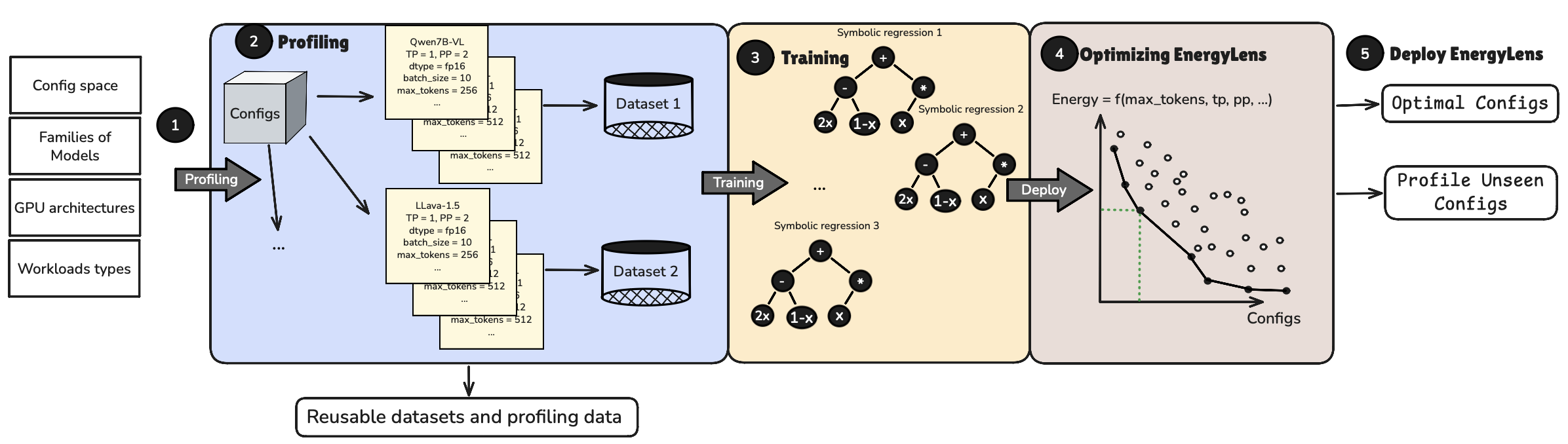
EnergyLens energy model overview

EnergyLens: Interpretable Closed-Form Energy Models for Multimodal LLM Inference Serving

Vittorio Palladino, G. Palermo, M. E. Papka, Z. Lan

In review: PDP 2027 · arXiv:2605.10556

As large language models span dense, mixture-of-experts, and state-space architectures, execute on heterogeneous accelerators, and support multimodal workloads, optimizing inference energy becomes as important as optimizing latency and throughput. Existing methods either treat latency as an energy proxy or depend on data-hungry black-box surrogates. Both break down across parallelism strategies: latency and energy optima diverge in 23.4% of our tested cases, while black-box models require hundreds of samples to generalize across models and hardware platforms. We present EnergyLens, which uses symbolic regression to discover a reusable, parallelism-aware structural template for LLM inference energy. After this one-time structure-discovery process, the template can be calibrated to a new model–hardware–workload combination using twelve coefficients. With as few as 50 measurements, EnergyLens achieves 84.6% Top-1 configuration-selection accuracy, versus 60.9% for the closest analytical baseline. It matches ensemble ML accuracy with 10× fewer samples, and adapts to new platforms without modifying the template.

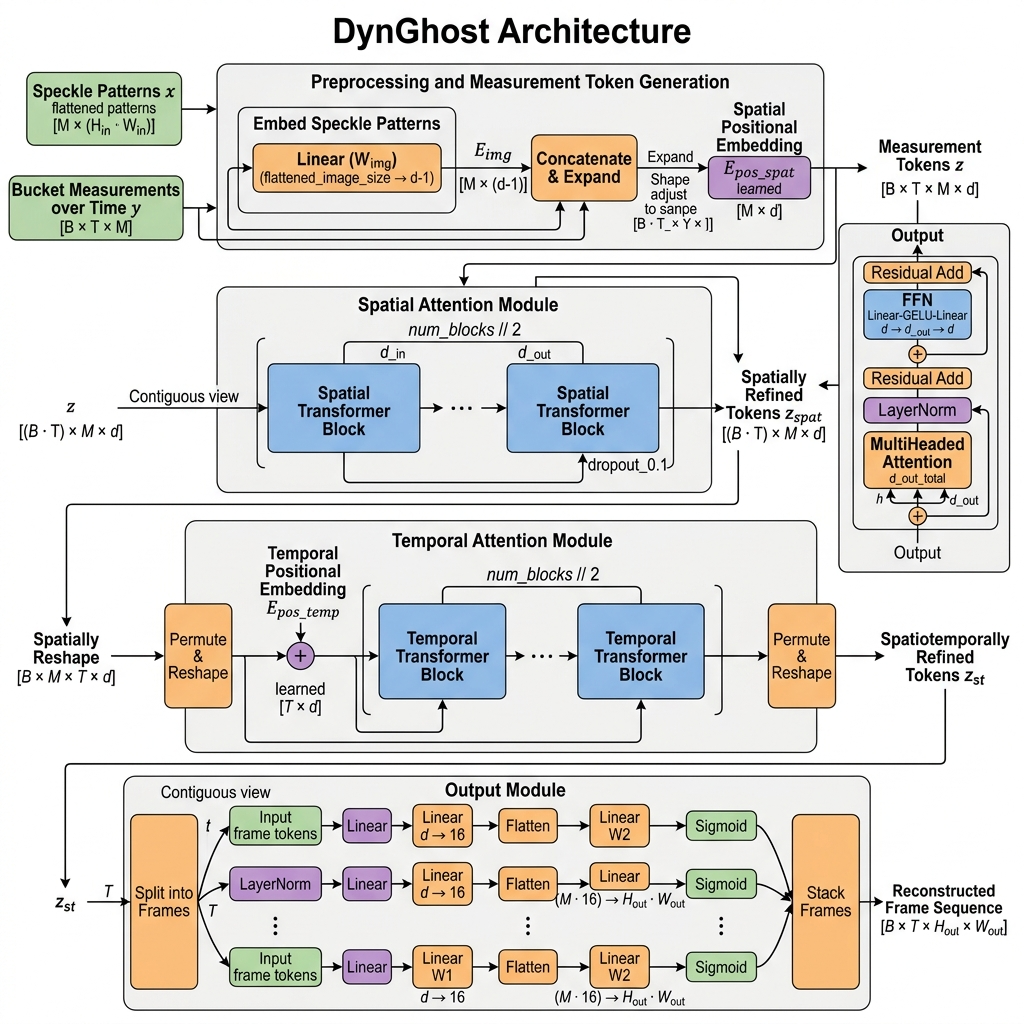
DynGhost dynamic ghost imaging transformer

DynGhost: Temporally-Modelled Transformer for Dynamic Ghost Imaging

Vittorio Palladino, A. E. Cetin

Accepted (Oral Presentation): Multimedia Signal Processing (MMSP), 2026 · arXiv:2605.10185

Ghost imaging reconstructs spatial information from a single-pixel bucket detector by correlating structured illumination patterns with scalar intensity measurements. While deep learning approaches have achieved promising results on static scenes, two critical limitations remain unaddressed: existing architectures fail to exploit temporal coherence across frames, leaving dynamic ghost imaging largely unsolved, and they assume additive Gaussian noise models that do not reflect the true Poissonian statistics of real single-photon hardware. We present \textbf{DynGhost} (Dynamic Ghost Imaging Transformer), a transformer architecture that addresses both limitations through alternating spatial and temporal attention blocks. Our detector-aware training framework, based on physically accurate hardware simulations (SNSPDs, SPADs, SiPMs) and Anscombe variance-stabilizing normalization, resolves the distribution shift that causes classical models to fail under realistic hardware constraints. Experiments across multiple benchmarks demonstrate that DynGhost outperforms both traditional reconstruction methods and existing deep learning architectures, with particular gains in dynamic and photon-starved settings.

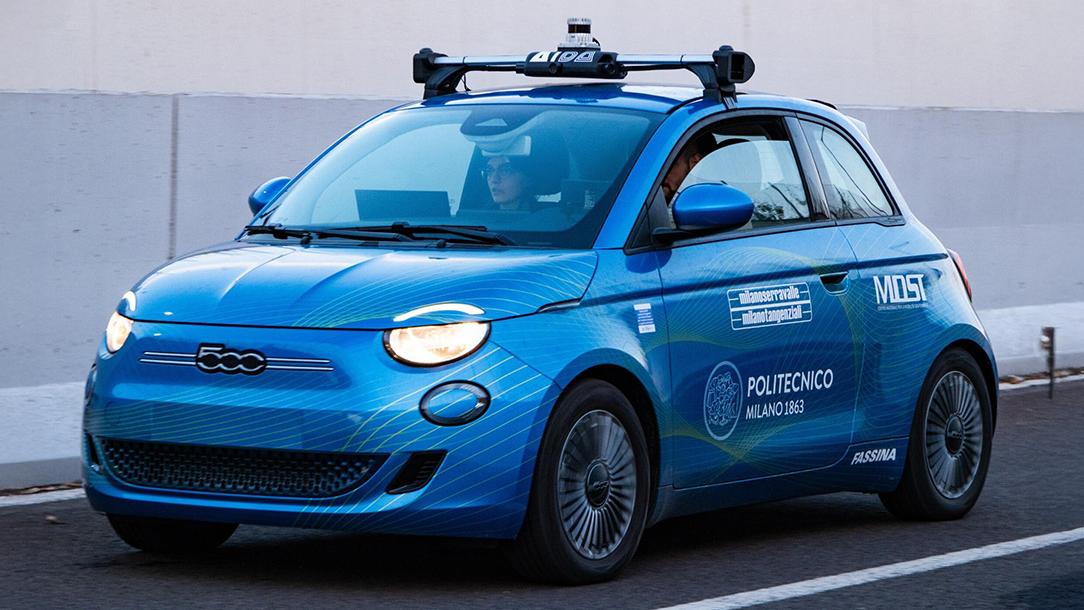
AIDA autonomous vehicle of Politecnico di Milano

Camera-Based 3D Object Detection as a LiDAR Backup for Autonomous Driving

Vittorio Palladino

Personal project · AIDA, Politecnico di Milano

We evaluate whether camera-only 3D object detection can serve as a reliable backup or complement to LiDAR for autonomous vehicles. We study two state-of-the-art multi-camera models, SparseBEV and StreamPETR, running pretrained inference and fine-tuning them on nuScenes and on a custom dataset collected with the AIDA vehicle, including a pseudo-labeled training set and the manually labeled AIDA-MDP-500 test set. StreamPETR achieves higher overall mAP and NDS, and fine-tuning it on pseudo-labeled data significantly improves detection on AIDA-MDP-500, while SparseBEV degrades when fine-tuned on the limited custom data. Our results show that camera-only models are a useful complement to LiDAR, but a performance gap remains.

News

  • 2026OA-MPPI, our occlusion-aware planner for quadrotor flight, is under review at ICRA 2027.
  • 2026FLAME is under review at ACM Transactions on Mathematical Software.
  • 2026Our paper DynGhost is accepted as an oral presentation at MMSP 2026!
  • 2026EnergyLens submitted to PDP 2026.
  • 2026Started visiting research at UC Berkeley — motion planning and LiDAR-based object detection for autonomous aircraft ground navigation.
  • 2026Research Assistant at UIC — energy-aware optimization framework for multimodal LLMs.
  • 2025Computer Vision Engineer at EssilorLuxottica Smart Eyewear Lab.
  • 2025Project at AIDA Autonomous Driving Team, Politecnico di Milano.

About me

Outside of research, I love travelling and discovering new places, and I enjoy going hiking whenever I get the chance.